
Find the Oman that fits your journey.
Start with a feeling, a region, or a must-see place. Then move from inspiration to a destination you can choose with confidence.
79 of 79 destinations visible
How do you want to experience Oman?
Choose a mood first. The page will reshape itself around the kind of journey you want.
Must See Oman
A curated first layer for travelers who want the icons before the deep cuts.
Let geography guide the story.
Move from the capital to the fjords, the green south, the mountains, and the sands.

It is a country of sudden contrasts.
Mountains rise from old trading towns, deserts open into quiet camps, and the coast carries stories from ports, turtles, islands, and souqs. The best journeys here are not rushed. They unfold.
Top Destinations

Muscat
Oman's coastal capital blends ancient heritage with modern elegance. A clean, safe, welcoming city with world-class architecture, pristine beaches, a historic old town, and easy access to day trips across the country.
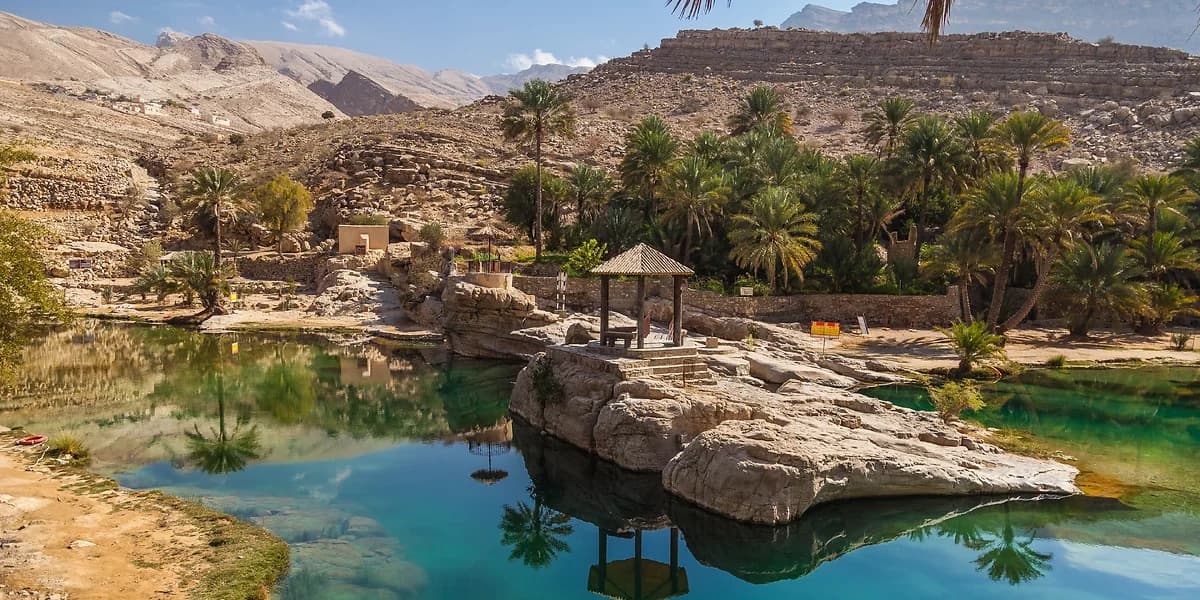
Wadi Shab
You swim through three pools before the canyon walls close completely and the light from the entrance disappears — then the gap in the rock reveals a cave, and inside the cave a waterfall drops from darkness into a lit pool where sound is entirely enclosed and everything reverberates. This is the moment that Wadi Shab exists for: a hidden cave with a waterfall inside a mountain, accessible only by swimming through the final passage.

Wahiba Sands
The first dune crest above camp at dawn — when orange sand meets blue-black sky and the silence is absolute except for wind movement — is the moment that makes everything about the Wahiba Sands worth it. These dunes reach 100 metres, formed over millions of years along a geological corridor that funnels sand from the Arabian interior toward the sea.

Jebel Shams
The wind at the canyon rim of Wadi Ghul comes from below — rising from a kilometre of vertical limestone you cannot fully comprehend until you stop walking and stand at the edge. Jebel Shams reaches 3,009 metres, but what makes it the finest high point in Oman is what it stands above: the deepest canyon in the Arabian Peninsula, dropping 1,000 metres to a wadi floor you can barely distinguish.

Musandam
Standing at the bow of a dhow moving through the Musandam khors, the fjord walls rise on both sides to 1,500 metres of bare limestone — the exact view that produced the name 'Norway of Arabia,' except the water is warmer, the dolphins are more numerous, and the scale is somehow more complete.

Nizwa
Oman's most important historical city, former capital in the 6th–7th centuries, and the country's cultural heartland. A UNESCO-recognized falaj system, one of the Arabian Peninsula's largest forts, and a famous traditional souq.
Salalah
In July, Salalah smells of wet grass, frankincense smoke, and sea mist — a combination that exists nowhere else in Arabia, produced by the Indian Ocean monsoon that turns Dhofar's coastal plain green while Muscat bakes at 45°C three hours north by air. The Khareef season runs June through September, during which the mountains above Salalah receive enough rainfall to feed waterfalls that are completely dry for eight months of the year.

Daymaniyat Islands
Drop beneath the surface and the reef appears immediately — brain coral the size of cars, reef sharks in slow arcs, hawksbill turtles gliding through blue water so clear the bottom is visible at 20 metres. These nine uninhabited islands hold the cleanest, most biodiverse reefs within reach of Muscat, protected since 1996 and never touched by shore development.

Ras Al Jinz
At 2am on the beach at Ras Al Jinz, a female green turtle that has navigated the Indian Ocean using the earth's magnetic field surfaces through the waves and begins the slow crawl up the sand to the precise spot where she was born — a 200-kilogram animal acting on a biological instruction so old it predates the Arabian Peninsula in its current form.

Bimmah Sinkhole
The sinkhole appears at the edge of Hawiyat Najm Park as a perfect circle of turquoise water cut into the limestone plateau — it looks designed, but the formation is entirely natural, caused by bedrock dissolution and the subsequent collapse of what had been cave ceiling.
Hidden Gems
Bandar Al Khayran
Paddle a kayak around a limestone headland and the world goes completely quiet — no roads, no buildings, just the drip of water off your blade and the hollow resonance of the sea cave opening ahead. This sheltered coastal reserve 40 km south of Muscat hides a network of coves, lagoons, and caves that can only be reached by water.

Salmah Plateau
Salmah Plateau is the kind of place that changes your sense of scale as soon as you climb onto it. The coast drops away behind you, the surface opens into a pale undulating highland, and the usual landmarks of travel disappear into track, rock, wind, and distance. What makes it memorable is not one single viewpoint but the feeling of being on a broad karst world with almost no visual clutter between you and the landscape.

Wadi Mistal
The road narrows through a cliff gap, then the valley opens without warning into the Ghubrah Bowl — a basin ringed by naked limestone that makes you feel the full scale of the Western Hajar in a single glance. Wadi Mistal is not a wading destination but a landscape destination, where acacia-dotted flatland leads upward into the high mountain villages of Wakan, Hadash, and Al Hijir.

Wakan Village
At 2,000 metres in the Western Hajar, Wakan smells different from every other village in Oman — in February and March the apricot orchards that ring the stone houses release a scent that carries across the entire valley. The village perches above the Ghubrah Bowl, its terraced gardens stepped down the slope below traditional stone architecture unchanged in generations.
Wadi Bani Awf
The descent from 2,000 metres of bare plateau through Snake Canyon to the Batinah Plain is the most dramatic off-road passage in northern Oman — narrow enough in places to feel the cliff walls through the window, steep enough to require total concentration, and long enough to understand what the Hajar Mountains actually are from the inside.
Wadi Sahtan
Wadi Sahtan opens into a wide mountain basin that feels more like a highland valley than a canyon — date palms, falaj channels, traditional villages, and the smell of woodsmoke from houses still inhabited the same way they have been for centuries. The wadi begins near Rustaq and extends into the Western Hajar through increasingly remote terrain that most visitors to the Rustaq Loop never reach.
Wadi Hoqain
The pools at Hoqain are a specific shade of mineral blue — not turquoise, not green, but a milky blue-green that signals dissolved limestone and cool mountain water filtering through the Western Hajar. A small waterfall drops into a picnic-friendly basin within walking distance of the village, making this one of the few places near Rustaq where families can swim without a strenuous approach.
Wadi Bani Hany
South of Hoqain and below the sight line of most Rustaq day-trippers, Wadi Bani Hany carries on as it always has — palm groves running along dry streambeds, stone buildings half-swallowed by vegetation, and the sound of water in channels that feed fields nobody outside the village will see today.
Adventure & Nature
Majlis Al Jinn
Stand at the edge of a 160-metre vertical shaft cut through solid limestone and listen: nothing, then a whisper of cool air rising from a chamber so vast it has its own weather system. Majlis Al Jinn is the second-largest cave chamber on earth by surface area — large enough to fit the Great Pyramid of Giza inside — accessible only by expert rappelling down one of three freefall entrance shafts.

Rustaq Loop
Three forts, a sulphurous hot spring, and mountain passes through date palms into bare limestone — all connected by a single circular road that most tourists miss while driving straight to Nizwa. The Rustaq Loop traces a semicircle through the oldest inhabited valley in Al Batinah, where water, trade, and military power have intersected for over a thousand years.

Little Snake Canyon
Between two canyon walls close enough to touch on both sides, the water is knee-deep, cold, and coloured a jade green that deepens with every step into the shade. Little Snake Canyon is the beginner entry point to the Wadi Bani Awf canyon system — shorter and less technical than Snake Canyon proper, but with the same limestone corridors and zigzag pools that define this mountain landscape.
Jebel Akhdar
In late March, the terraces of Jebel Akhdar smell of roses — not the faint garden variety, but the concentrated attar of Damask roses being harvested and distilled in small copper stills that have worked this same mountain for three hundred years. At over 2,000 metres, the Green Mountain holds a microclimate that allows the only commercial rose cultivation in the entire Arabian Peninsula.

Wadi Bani Habib
A stone path with 200 steps descends from the viewpoint into a canyon where abandoned houses stand intact above apricot orchards that still bloom every spring despite no one tending them. Wadi Bani Habib is Jebel Akhdar's most evocative site — an entire village left in such precise condition that you can stand in a doorway and understand exactly how the rooms were arranged.

Wadi Nakhr
From the village of Ghul on the canyon rim, Wadi Nakhr stretches below in a series of layered limestone terraces and narrow wadi floors so far down that the vegetation looks like moss — this is the grand view of Oman's most dramatic canyon system, accessible to anyone willing to drive to the edge.

Al Hoota Cave
In the underground lake at Al Hoota Cave, small pale fish move through the water with precise navigation despite having never evolved eyes — the Garra barreimiae has lived in permanent darkness long enough that sight became irrelevant. The cave extends 4.5 kilometres beneath the Hajar Mountains, formed over two million years, and the illuminated section contains enough stalactites and underground lakes to make the 45-minute guided walk one of the strangest landscapes in Oman.

Hat Village
Hat is not the kind of place that arrives with ticket booths, signs, or a performance of authenticity. You reach it on one of Oman's great mountain crossings, after the drama of Wadi Bani Awf and before the high saddle of Sharaf Al Alamayn, when the road becomes quieter and every bend feels like it belongs more to the mountains than to you. The village itself is modest, but that is part of the appeal: stone homes, terraces, and a setting that makes the whole stop feel like a pause inside the landscape rather than beside it.

Wadi Tanuf & Tanuf Ruins
Tanuf is the kind of place that slows you down before you realise it has. A turn off the main road between Nizwa and Bahla leads into a broad canyon mouth where mudbrick walls stand half-dissolved into the earth, the cliffs of the Hajar rising behind them like a stage set too large for the village below. Walk a little farther and the mood changes again: the wadi opens, palms and water soften the scene, and the whole place becomes less about ruins than about how beautifully life once fit into this landscape.

Wadi Hawir
Somewhere inside Wadi Hawir, after 20 minutes of scrambling through wet rock and swimming across a pool you cannot touch the bottom of, a 40-foot waterfall drops into a chamber that no road reaches. The wadi runs parallel to the famous Wadi Bani Khalid but shares none of its infrastructure — no café, no paved path, no restrooms, and rarely anyone else.
Relax & Scenic

Barka
On Friday mornings between October and April, the sandy arena behind Barka fills with the sound of shoulder meeting shoulder and hooves striking earth — the bull-wrestling event that has taken place here for centuries, a test of strength between bulls with no blood and no harm, where the loser simply retreats.

Sohar
One of Oman's oldest cities and the legendary birthplace of Sinbad the Sailor. Once the wealthiest port city in the Arab world, Sohar combines history and contemporary amenities between the Hajar Mountains and the Arabian Sea.
Salut
Salut does not overwhelm you through size alone. Its power comes from placement: a fortified hill rising above an oasis plain, with the sense that every wall, terrace, and passage was built because water, defence, and survival once had to work together with absolute precision. Walk it slowly and the site begins to feel less like a ruin and more like a high vantage point into how inland Oman first learned to organise settlement at scale.

Al Hamra & Misfat
Water runs through Misfat Al Abryeen in channels carved from rock centuries ago, feeding terraced gardens of date palms and orchards that hang off a stone outcrop like a village impossibly balanced on the Hajar foothills. The sound of running falaj water is constant here — it defines the texture of the place in a way that makes Misfat immediately distinct from every other heritage village in Oman.

Al Hamra Old Town
Al Hamra Old Town is the kind of place that rewards a slower pace almost immediately. The lanes are narrow, the walls are textured by age rather than polish, and the whole settlement seems to sit somewhere between endurance and elegance. Walk through it in soft light and what stands out is not only the architecture itself, but the feeling that the town still carries its own memory in doorways, stairways, and shadowed passages.

Birkat Al Mouz & Bait Al Radidah
Birkat Al Mouz has the rare kind of beauty that unfolds in layers. First come the date palms and the long line of ruined mudbrick houses, then the sound of running water, then Bait Al Radidah rising at the edge of the village with Jebel Akhdar behind it. Nothing here feels isolated from anything else. The fort, the falaj, the orchards, and the old village all belong to one continuous landscape, which is exactly why the place feels more alive than most heritage sites ever do.

Harat Al Bilad
Harat Al Bilad is one of those places that does not need drama added to it. You arrive in Manah, step toward the old quarter, and suddenly the scale of traditional settlement planning becomes visible all at once: walls, gateways, towers, lanes, and the dense geometry of homes once built for heat, defence, and community rather than spectacle. What stays with you is not only the age of the place but how complete the atmosphere still feels.

Bahla Fort
The mud-brick walls of Bahla stretch for 12 kilometres around the oasis town — a fortification so vast that its full scale only becomes clear from the road, where the ramparts appear and disappear behind date palms for minutes at a time. Oman's first UNESCO World Heritage Site is not a single building but an entire ancient urban system: fort, town walls, oasis, and traditional market still functioning together.

Jabrin Castle
Look up at the ceiling of Jabrin Castle's main hall and the painted panels tell a story in colours — botanical, geometric, celestial — that have survived without restoration since 1670. The Imam who commissioned this castle created something Oman did not repeat: a royal residence that was simultaneously a centre of Quranic learning, with study rooms built into military architecture in a way that makes the building feel genuinely inhabited by ideas.

Bidiyah Dunes
The golden wall of the Sharqiya Sands rises directly behind Bidiyah town without transition — no gradual slope, no warning landscape, just tarmac ending and dune beginning. This northern access point to the Wahiba Sands is the easiest place in Oman to be standing in a real desert within three hours of Muscat.
Al Mudhairib
Al Mudhairib is the kind of place that rewards a deliberate stop. From the main route it looks modest, but once you step into the old quarter the mood changes quickly: narrow lanes, restored and ruined structures side by side, and watchtowers positioned as if the village still expects to keep an eye on the horizon. It feels less curated than many better-known heritage sites, which is exactly why it leaves a stronger impression.

Ibra
On Wednesday mornings, Al Minzafah market fills with Omani women selling spices, silver jewellery, embroidered cloth, and medicinal herbs to other Omani women — one of the only women-dominated market spaces remaining in the country, where men may enter the periphery but the dynamic and the commerce are entirely controlled by the sellers.
Wadi Dima
The rock in Wadi Dima is not the beige limestone of the coastal wadis but polished ophiolite — dark green and brown oceanic crust pushed to the surface millions of years ago, creating pools with a different quality of light and depth than anywhere on the Sur highway. The wadi extends from the Al Sharqiyah Expressway into the Eastern Hajar through palm groves, white calcite deposits, and water running blue-green from the mineral content of the springs.

Wadi Al Arbeieen
The approach to Wadi Al Arbeieen follows a rough track past villages where residents have watched the same wadi fill and recede with every rain for generations — before you reach the water, you have already understood that this is not a managed tourist site but an actual Omani landscape. The pools are deep and turquoise, set below canyon walls that rise sharply enough to cast long morning shadows across the water well into the afternoon.

Wadi Dayqah Dam
The turquoise of the Dayqah reservoir sits between ridgelines of jagged Eastern Hajar limestone in a colour combination that looks engineered but is entirely geological — dark rock, pale water, and a haze above the dam wall that carries sound differently than open land. Oman's largest dam opened in 2012, and the reservoir it created is now large enough to kayak for hours without doubling back.

Wadi Tiwi
The tarmac road into Wadi Tiwi is narrow enough that two passing cars require one to fold the mirror — but the drive through the gorge past inhabited villages, orange rock walls, and terraced date palm gardens is the most scenic wadi drive on the coastal highway, and almost nobody takes it because Wadi Shab is 500 metres away.

Wadi Mibam
Above Mibam village, where the road becomes a path and the path becomes a rope-assisted scramble, a waterfall drops into a pool that sees fewer than a hundred visitors a year. The descent is steep enough to require care on wet rock, dramatic enough to make the effort feel earned, and positioned deep enough inside Wadi Tiwi that the silence at the bottom is complete.

Fins Beach
The rocky headlands at Fins close around the bay like a natural wall, and the water inside the enclosure goes through three distinct shades of blue from shore to deep — pale turquoise over sand, aquamarine over rock, and a deep indigo beyond the reef edge where the snorkeling begins to get serious.

Sur
In the dhow yard south of Sur, men work wood with adzes and planes shaped from memory rather than instruction manuals — the same tools, the same joints, the same proportions that carried Omani merchants to Zanzibar and the Malabar Coast for a thousand years. The sound of the yard in the morning, hammers and the smell of teak and sealant, is a working environment that happens to be one of Oman's most remarkable living heritage sites.

Pink Lake Oman
The pink is not guaranteed and not permanent — it appears when the salinity, the Dunaliella algae bloom, and the angle of midday light align, which can happen on any bright day between autumn and spring and disappear entirely after tidal mixing. When the conditions are right, the lagoon near Al Suwaih turns a colour that exists nowhere else in Oman and almost nowhere on the Arabian Peninsula.

Wadi & Sadd Al Aqeeda
This is the kind of place you go when you want the day to feel wider, quieter, and less scheduled. Around Wadi Naam and Sadd Al Aqeeda, the landscape opens into low desert hills, village edges, and rain-fed channels that only show their best character when the season has been kind. When water gathers behind the dam or moves through the wadi after good weather, the whole area shifts from ordinary to deeply calming in the span of a single turn off the road.

Masirah Island
From June through September, the wind at Masirah comes from the south at 25 to 35 knots with a consistency that professional kitesurfers call the most reliable wind corridor in the Middle East — long flat-water runs, thermal lift from the heated land, and conditions that coaches pay for their athletes to train in.

Ibri & Bat Tombs
The beehive tombs at Bat rise from the hillside in their original positions — not reconstructed, not fenced into an interpretive trail, but sitting where they were placed five thousand years ago by people whose civilisation left almost nothing else this well-preserved anywhere on earth. The UNESCO designation acknowledges what the landscape makes obvious: these tombs are the primary evidence that an organised Bronze Age society managed the copper and frankincense trade here at the same time Egypt was building pyramids.

Al Ayn Beehive Tombs
Al Ayn is the kind of place that feels cinematic before it feels historical. The tombs stand one after another along a rocky ridge above Wadi Al Ayn, each one small enough to approach on foot but together powerful enough to hold the whole landscape still. With Jebel Misht rising behind them and the wadi opening below, the site offers something rare: ancient architecture that still feels completely at home in its original setting.
Wadi Damm
The polished ophiolite rock at Wadi Damm is so smooth and coloured so specifically — dark green-brown with veins of lighter stone — that the canyon floor looks surfaced rather than natural. Seasonal pools collect in bowls worn into the rock by centuries of water movement, and petroglyphs pecked into the cliff face near the canyon mouth document a human presence here from approximately 600 BC.
Al Kittan Cave
Al Kittan Cave lies near Al Iraqi, about 8 kilometres from Ibri, in the limestone country of Ad Dhahirah. Official Omani tourism material consistently describes it as the 'marble cave' because of the pale, highly reflective cave walls, but it is better understood as a protected wild karst cave rather than a developed show cave. Inside are stalactites, stalagmites, and older rock markings that give the site both geological and human depth.

Al Buraimi
Al Buraimi shares a continuous streetscape with Al Ain across a border that has been meaningful for only 50 years — before that, this was a single Buraimi Oasis where trade routes from the Persian Gulf, Arabia, and the Indian Ocean interior converged, watered by 49 separate falaj irrigation systems still carrying water through the same channels they were designed for.
Barr Al Hikman
At low tide on Barr Al Hikman, the tidal flat extends so far in every direction that the horizon becomes ambiguous — land and sky the same pale colour, water only visible at the edges where flamingos wade through six centimetres of sea. Oman's largest tidal plain, at 2,900 square kilometres, was designated a Ramsar Wetland Site in 2023, recognising what the 130-plus bird species that migrate through here already knew.

Mahout Wetlands
At dawn in the Mahout wetlands, the sound arrives before any image is possible — a continuous layered noise of waterbirds from hundreds of species using the mudflats, mangroves, and shallow lagoons of one of the least-visited Ramsar sites in the Arabian Peninsula.

Duqm
The rock formations at Al Haqf have been shaped by 46 million years of wind erosion working on sandstone that doesn't exist anywhere else on Oman's coast — mushroom columns, arched bridges, and free-standing towers in a palette of ochre, cream, and rust that changes colour completely between morning and afternoon.

Arabian Oryx Sanctuary
Arabian Oryx Sanctuary is the kind of destination that changes shape once you understand what you are looking at. At first it can seem like open desert on a grand scale - long horizons, spare vegetation, pale light, and silence. Then the context catches up with you: this is one of the landscapes most closely associated with the return of the Arabian oryx after the species had vanished from the wild, and suddenly every track, every sighting, and every hour of patient scanning feels heavier with meaning.
Al Khaluf Sugar Dunes & Beach
The Sugar Dunes at Al Khaluf are white — not the warm tan or golden rust of the Wahiba Sands, but a pure mineral white formed from crushed shell and quartz that the coastal wind continuously reshapes against the deep blue of the Arabian Sea behind it.

Ras Madrakah Black Beaches
At Ras Madrakah, black basaltic rock formations rise directly from white sand in formations that look deliberately placed but are the result of coastal erosion working on two very different geological materials at different rates. The fishing village nearby operates with complete indifference to visitors — boats in at dawn, nets spread on the beach, the smell of diesel and fish in the morning air.

Al Marnif Cave
During high tide in Khareef, the blowholes at Mughsail detonate — seawater forced through limestone fissures by wave pressure erupts from holes in the platform 10 metres above sea level, producing a sound like a controlled explosion and a spray column that reaches 20 metres before the wind carries it.

Wadi Dawkah
The Boswellia sacra trees at Wadi Dawkah look almost deliberately modest — gnarled, low, pale-barked and leafless through much of the year, producing no visual signal that explains why the frankincense they yield has been the most valuable aromatic commodity in human trade for four thousand years. Break a small resin droplet from a fresh scar and the smell is immediate and specific: clean, warm, slightly lemony — the scent at the core of every major religious ritual from ancient Egypt to contemporary Oman.

Rub' al Khali
The Empty Quarter has a way of making every other desert feel smaller. Once you leave the greener face of Dhofar behind and push north toward the dune country, the landscape begins to simplify into sand, sky, and scale so large that it almost stops reading as scenery and starts reading as exposure. What stays with most people is not one dramatic moment, but the accumulation of them: the size of the dune lines, the silence between gusts, the way the light moves across the sand as if the whole desert were breathing slowly.

Wadi Darbat
During Khareef, a waterfall drops from the eastern cliffs of Wadi Darbat into a lake that is completely still despite the motion above it — the mist off the fall, the cattle grazing the green slope, and the camels that materialise through the fog create a scene that looks fabricated by someone designing a landscape that doesn't actually exist anywhere else in Arabia.

Khor Rori
Khor Rori is one of those rare places where the landscape and the history improve each other. The lagoon sits low and calm behind the coast, often full of still reflections and bird movement, while the stone remains of Sumhuram rise above it with the sort of confidence only an ancient port can carry. Stand there long enough and the site stops feeling like a ruin beside water and starts feeling like a complete scene: trade, tide, wind, birds, and a route that once connected Dhofar to much larger worlds.

Jabal Samhan
From the Jabal Samhan escarpment viewpoint, the coastal plain of Dhofar stretches below at an angle so steep that the town of Mirbat 1,500 metres beneath appears as a miniature — and somewhere in the 4,500 square kilometres of protected mountain behind you, the last wild Arabian leopards in Oman move through a limestone plateau where almost nobody goes.

Teeq / Taiq Cave & Sinkhole
Teeq Cave is not technically a cave but a collapsed one — the roof of a karst system dissolved and fell, leaving a bowl 250 metres wide and 150 metres deep that sits in the Dhofar plateau with the vertical scale of a sinkhole and the horizontal scale of a stadium. During Khareef, seasonal waterfalls pour over the rim from multiple directions simultaneously into the darkness below.

Tawi Atair Sinkhole (Well of Birds)
Stand at the viewing platform at Tawi Atair and listen before you look — the bird calls rising from 211 metres below are delayed, changed in quality by the acoustics of a vertical shaft in solid limestone, producing sounds that seem to come from somewhere outside the normal geometry of space. The Well of Birds is named for what you hear before you see it.

Ayn Hamran
The shade under the sidr trees at Ayn Hamran is different from shade in a built space — it is the shade produced by high moisture, multiple overlapping canopies, and the cooling effect of a spring flowing below the root system, dropping the temperature five degrees more than the shadow alone accounts for.

Ayn Razat
Ayn Razat's lily ponds are fed by a spring that has never been recorded as dry — a permanence that explains why this site has been continuously visited since before Salalah was a city, when the Dhofar plain supported agricultural settlements dependent on exactly this kind of reliable water source.

Ayn Garziz
The tufa formations at Ayn Garziz are built by calcium-carbonate-rich water precipitating on contact with air — a geological process slow enough that the terraces you walk across today were centuries in the making, shaped by the same spring that fills the pools at your feet.

Ayn Athum
The limestone overhang at Ayn Athum holds the shape of a natural amphitheatre — water drops from its lip into a pool below during Khareef, and the sound of the fall is contained and amplified by the concave rock above, creating a reverberation that carries farther into the valley than any other waterfall near Salalah.

Ayn Khor
The approach to Ayn Khor follows a wadi track west of Raysut that becomes progressively rockier as the valley narrows — the waterfall at the end appears suddenly around a canyon corner, dropping from a notch in the cliff into a pool that catches the afternoon light in a way the photographs from above never capture.
Wadi Sahalnoot
The road through Wadi Sahalnoot is narrow and fog-prone during Khareef — but the mist that reduces visibility on the bends also drops the temperature by 10 degrees, saturates the valley in green, and produces the specific sensory experience of driving through a living monsoon landscape that is the fundamental reason people come to Salalah in July.
Al Hallaniyat
The visibility in the water around the Hallaniyat Islands is not measured in metres the way most dive sites are — conditions regularly allow visual contact with the reef from the boat surface, meaning the descent is a continuous clarification of detail that begins before you hit the water.
Mirbat
Mirbat's old houses are built from coral block — not limestone, not mudbrick, not concrete, but the actual skeletal calcium carbonate of reef organisms harvested from the sea below, creating walls that feel chalky under the hand and have a texture completely unlike any other building material in Oman. The fort above the old town is the same material, fused over centuries into a structure that has watched every kind of weather the Indian Ocean produces.

Marble Mountain
Travellers call it Marble Mountain because that is what it feels like at first glance: a white, sculpted wall rising above the coast as if someone had sliced open a mountain and polished the inside. The closer you get, the more interesting it becomes. This is not a distant peak to admire and leave behind, but a roadside geological surprise near Hasik where the stone itself seems to be softening, folding, and dripping downward in long pale tongues against darker rock.

Wadi Bani Khalid
The turquoise of Wadi Bani Khalid's pools is the specific colour of limestone-filtered water at its most concentrated — a shade that exists in photographs but still surprises in person, set against white canyon walls and date palms watered by this same source for centuries. Of the hundreds of wadis in Oman, Bani Khalid is the only one with flowing water every single day of the year.
Where will you go first?
Turn discovery into a route, a weekend, or a full Oman itinerary.